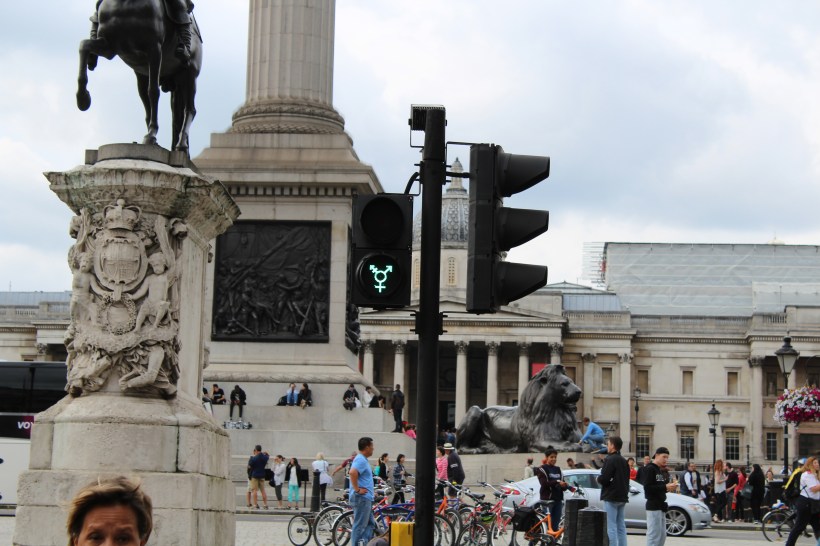
What is gender? How would you define it? If you were asked to write a 500 word essay explaining your gender instead of checking a box M/F on a form, how would you describe your gender? Take a photo of anything to personalize this first post and upload it with your first entry. Due June 21 at noon.
Gender is a complex relationship between one’s own identity and broader cultural and social constructions of the relationship between the sexes. Gender is not a binary. Gender is shaped by one’s sex as well as one’s class, race, religion, nationality, and other factors such as one’s sexuality. When a form asks a person to identify their gender and then it offers two boxes – tick M for male of F for female, the form is really asking for individuals to reveal their biological sex.
My own gender identity has always been somewhat non-conforming. I have always been mot interested in occupations and pastimes were labeled “for boys.” I had no interest in dolls, even though my mom kept buying them for me. My brother’s G.I. Joe had cool things like a canoe, and scuba equipment. G.I. Joe did things. The dolls my mom gave me for Christmas just sat there and had outfits. There is only so much fun one can have changing the clothes on a doll. Then what? I wanted to be a boy scout. They built fires and went on hikes. I didn’t want to sell cookies. I wanted to carve wood and go camping. I wanted to play baseball. But as a girl, I conformed. I quit soccer because my Argentine brother-in-law informed me soccer was really a boy’s sport. I played volleyball. That was fun. I played piano, but at home I still preferred chores that were outside, like mowing the lawn over cleaning the house. I got an expensive perm for my hair, wore dresses and expensive make up, and felt like a bit of a fraud. I felt more like myself in sweats and a t-shirt without make-up. I found myself trying to explain that I felt neither female nor male, like I was unique, or more disparagingly that sometimes I felt like a spore. I didn’t have the language for a complex gender identity. I tried many different majors once I went to university – including piano performance, and environmental science. I transferred schools and tried nursing school for a year, but switched again. I had really wanted to be a doctor or a physical therapist, but thought that would be unrealistic. No woman in my family had ever graduated with a B.A. or B.S., forget about graduate school. But nursing for me was too distinctly “female” as a profession. When I finally found my direction in academics – and realized that I could pursue a Ph.D. if I wanted to, I felt at home. Nowhere else did it seem less relevant if you were male or female – only that you were a person who worked hard to think through difficult questions and who challenged themselves to achieve rigorous standards of clarity in writing and research. When I had children I continued to learn how individual and variable one’s own identity is compared with simplistic categories of sex differentiation based on the binary of male and female.

